
An AI MVP and a traditional MVP serve the same business purpose: expose the smallest credible version of a product to real users so a team can learn whether the problem, promise, and commercial model deserve more investment. The difference is what must be proven. A traditional MVP mainly tests whether people want a workflow. An AI MVP must also prove that a probabilistic system can produce useful results, at an acceptable cost and speed, with failures users can understand and recover from.
This distinction matters because the phrase “AI MVP” is used for two different things. It can mean an MVP whose core product behavior is powered by a model. It can also mean an ordinary product built faster with AI coding assistants. Those are not the same decision. A booking application generated with an AI coding tool is still a traditional, deterministic product if its user-facing behavior follows fixed rules. A document-review product built entirely by human engineers is still an AI MVP if a model’s interpretation is central to the value.
This guide compares the first meaning: an AI-powered MVP versus a traditional software MVP. It also shows where AI-assisted development changes delivery speed—and where it does not remove the need for architecture, testing, security, or product judgment.
AI MVP, traditional MVP, prototype, and proof of concept
A minimum viable product is not merely the fastest interface a team can demo. It is a coherent product that a real user can use for a real purpose. Y Combinator’s practical MVP guidance makes a useful distinction: a prototype demonstrates an idea, while an MVP is used by customers as a product. That means “viable” includes enough reliability, clarity, and support for the chosen audience—not every feature on the roadmap.
A traditional MVP implements its core behavior with deterministic software. Given the same valid input and system state, the product should produce the expected result. Examples include an appointment marketplace, a subscription dashboard, a simple project tracker, or an approval workflow. These products can contain search, rules, calculations, and automation without becoming AI products.
An AI MVP depends on a model or inference system for a meaningful part of its customer promise. Examples include extracting obligations from contracts, ranking support conversations by risk, generating a first draft from source documents, detecting defects in images, or recommending the next best action. The model can be purchased through an API, hosted as an open model, or trained by the team. The sourcing choice changes implementation effort, but it does not remove the need to evaluate system behavior.
A proof of concept answers “can this mechanism work under controlled conditions?” A prototype answers “can users understand and react to this experience?” An MVP answers “will a defined customer use or pay for this complete, narrow outcome in the real world?” For an AI product, teams often need all three—but they should not quietly relabel a successful demo as a production-ready MVP.
What are you actually building?
Choose the closest description. The result separates product behavior from the tools used to write the code.
AI may help build it, but the customer-facing product does not depend on model behavior.
AI MVP vs traditional MVP at a glance
| Decision area | Traditional MVP | AI MVP |
|---|---|---|
| Primary hypothesis | Users want this workflow and outcome. | Users want the outcome, and the model can deliver it well enough to trust. |
| Behavior | Mostly predictable from rules and state. | Probabilistic, context-sensitive, and sometimes surprising. |
| Data | Supports records, reporting, and transactions. | Also shapes model context, evaluation, retrieval, tuning, and monitoring. |
| Testing | Expected inputs, outputs, permissions, and edge cases. | All traditional tests plus representative evaluations, adversarial cases, and human review. |
| Failure | Usually an exception, validation error, or incorrect state. | Can be plausible but wrong, inconsistent, unsafe, biased, slow, or unexpectedly expensive. |
| Cost shape | Build cost plus relatively predictable hosting and support. | Build cost plus variable inference, evaluation, data operations, and model change management. |
| Iteration | Change code, tests, configuration, or workflow. | May also change prompts, model, retrieval, datasets, thresholds, and review policy. |
| Launch gate | Core task works reliably and users value it. | Core task works, users value it, and measured model behavior stays within explicit tolerances. |
The table does not imply that every AI MVP is harder than every traditional MVP. A narrow summarization feature built on an existing application can be simpler than a multi-sided marketplace with payments, scheduling, disputes, and complex roles. The useful comparison holds the product shell roughly constant and asks what the AI-dependent task adds: data work, evaluation, fallback design, variable costs, and operational uncertainty.
1. The validation hypothesis has an extra layer
A traditional MVP asks whether a target customer experiences the problem strongly enough to adopt a narrow solution. The evidence might be completed tasks, repeat use, paid pilots, shorter cycle time, fewer errors, or willingness to switch from a spreadsheet. The core product question is behavioral: does the workflow create enough value?
An AI MVP asks that same market question, then adds a technical-product question: can the model-assisted experience produce an outcome users accept under realistic conditions? A founder can discover that customers desperately want faster contract review while also discovering that the system misses the exceptions they care about. Conversely, a team can build an impressive evaluator score for a task nobody prioritizes. Neither result is an MVP success.
This is why AI teams should track two evidence streams from the start:
- Value evidence: task completion, repeat use, retention, paid conversion, time saved, avoided loss, or another observable business outcome.
- behavior evidence: task success on representative examples, severe-error rate, consistency, latency, cost per successful task, and how often humans intervene.
Do not combine them into one flattering score. A product can have strong technical performance and weak demand, or strong demand and unacceptable model risk. Keeping the axes separate makes the next experiment obvious.
Market versus technical uncertainty
Rate each uncertainty from 1 to 5. The highlighted quadrant recommends the next evidence to collect.
Use interviews, a concierge service, landing-page commitment, or a paid design partner before building model infrastructure.
Test demand with a manual workflow while independently testing the riskiest model task on representative examples.
Both risks are manageable. Release to a small cohort with monitoring and a visible recovery path.
Build an evaluation set and compare a simple rule, human baseline, and candidate model before polishing the product.
Neither question is settled enough to justify a full build. Separate the experiments so one positive result cannot hide the other risk.
2. Traditional software promises rules; AI products promise tolerances
In deterministic software, requirements usually describe exact behavior: a user with this role may approve this record; a payment over this threshold requires a second check; an invalid date is rejected; a completed order produces a receipt. Bugs still happen, but the intended answer is usually knowable.
AI behavior is different. A model can produce several acceptable answers, and the same input can yield variation across models, settings, prompts, context, or time. Product requirements therefore need both examples and tolerances. “Write a helpful summary” is not a launch criterion. “Capture every material obligation in our representative evaluation set, never invent a date, cite the source passage, and route uncertain cases to a reviewer” is much closer.
The practical implication is not that AI products can be vague. It is the opposite: teams must define acceptable behavior more concretely because the mechanism is less predictable. Good specifications describe the task, user, context, failure severity, measurable thresholds, prohibited behavior, and fallback. They also distinguish a harmless style variation from an error that could cause money, safety, privacy, or trust damage.
3. Data is not merely storage—it is part of product behavior
Traditional MVPs still need disciplined data design. They require clear entities, permissions, validation, retention, backup, and reporting. But the product can often begin with an empty database and behave correctly as users create records.
An AI MVP may depend on data before the first user arrives. The team might need representative documents for evaluation, labeled examples for classification, product content for retrieval, historical outcomes for prediction, or policies that define what the system may disclose. The central questions are not only “do we have data?” but also:
- Do we have the right to use it for this purpose?
- Does it represent the users and edge cases in the initial market?
- Is it accurate, current, consistently formatted, and traceable?
- Can we separate development examples from a credible evaluation set?
- Can we remove or protect sensitive information?
- Who owns updates when the source changes?
A common failure pattern is to design a retrieval or prediction architecture around a data source the team cannot reliably access. Another is to evaluate only on polished examples collected by the builders. The demo looks good because the inputs resemble the prompt author’s assumptions; real usage exposes missing context, ambiguous language, poor scans, unusual categories, and adversarial requests.
Google’s Rules of Machine Learning recommends starting with simple mechanisms and designing metrics before formalizing the ML system. That advice is especially relevant to an MVP. A manual baseline or transparent rule can collect the examples needed to decide whether a model is warranted.
Traditional, AI, or hybrid?
Answer six product questions. The result is a starting architecture, not a substitute for discovery.
The use case may justify AI, but data or economics still need evidence. Put the model behind a reviewable boundary.
4. AI adds a behavior layer to otherwise normal product architecture
Founders sometimes sketch an AI MVP as a chat box connected to a model API. That can be enough for a prototype, but the viable product around it is still software: authentication, tenancy, permissions, billing, source records, integrations, analytics, support, and a way to correct mistakes. The model is a component inside that system, not the system itself.
A narrow API-led AI MVP commonly includes six layers:
- Product interface: the task, context, expectations, and recovery controls visible to the user.
- Application logic: roles, workflow state, validation, business rules, and deterministic calculations.
- Context preparation: approved instructions, retrieved sources, structured fields, and input limits.
- Model interaction: the selected provider or hosted model, configuration, structured output contract, and timeout policy.
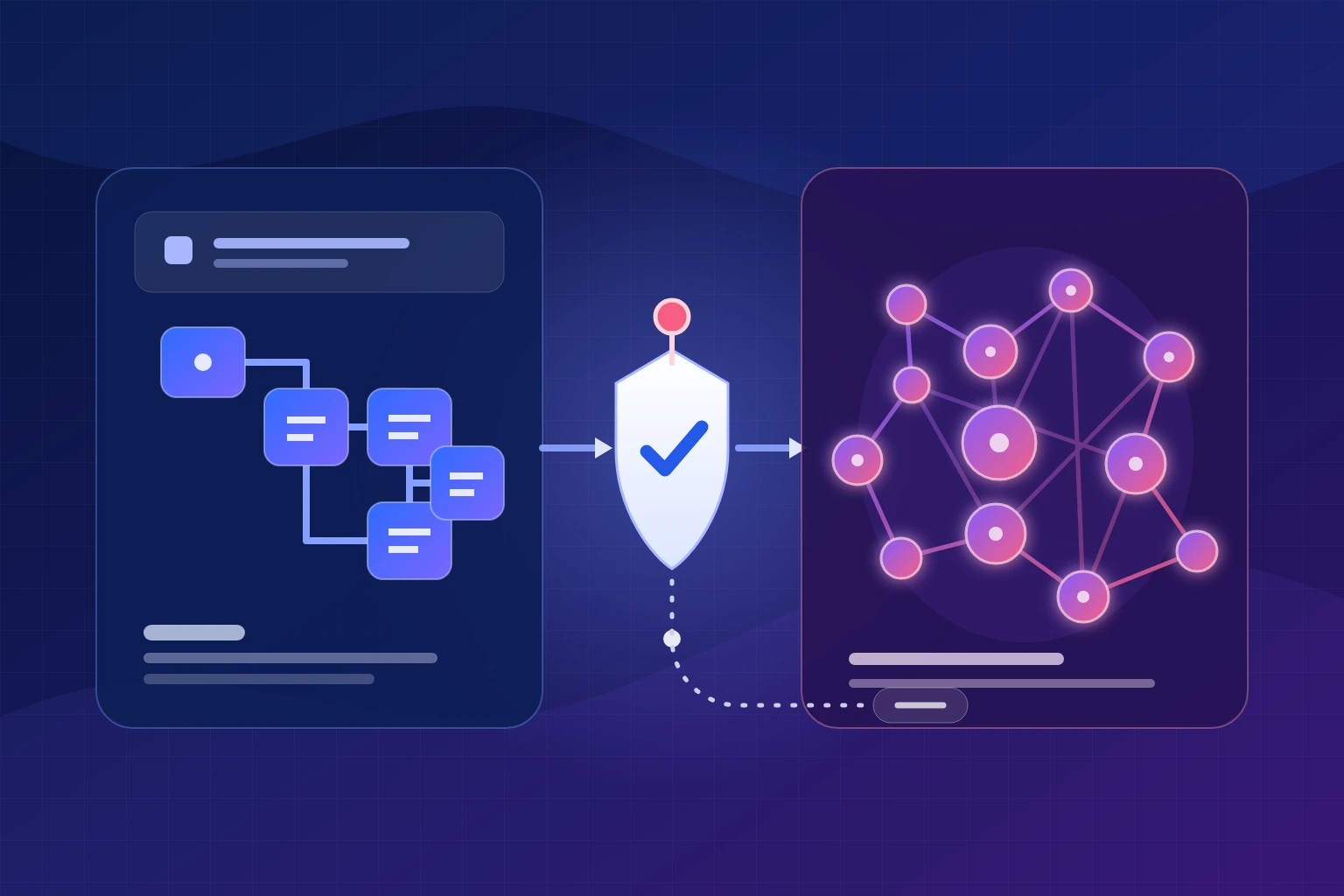
- Validation and fallback: schema checks, citations, policy rules, confidence signals, retries, and human review.
- Evaluation and telemetry: versioned examples, user feedback, latency, cost, error categories, and release comparisons.
A traditional MVP has analogues for most of these layers, but model interaction introduces a moving dependency. A provider can release a new version, alter limits, change pricing, or retire a model. A prompt or retrieval update can improve the average score while quietly making one customer segment worse. A safety filter can reject valid domain language. The product needs versioning and observability at the behavior boundary, not only uptime monitoring around the API.
The safest early architecture is usually narrow and replaceable. Put model calls behind an application service rather than scattering prompts through the interface. Store the prompt or policy version with each result. Preserve enough trace data to investigate errors without logging secrets indiscriminately. Validate structured responses. Set budgets, timeouts, and rate limits. Design the non-AI path before launch, not after the first outage.
AI-assisted development changes throughput, not product truth
AI coding assistants can make both delivery paths faster. They are useful for exploring an unfamiliar codebase, scaffolding ordinary components, drafting tests, translating a design into a first implementation, documenting interfaces, and proposing fixes. That can shorten the time between a product decision and something a user can try. The gain is real when experienced people review the output and the team keeps the scope coherent.
The tools do not decide whether a requirement is wise, whether an abstraction fits the system, or whether the generated code preserves security and privacy expectations. They can reproduce a flawed assumption at high speed. They can also produce a plausible implementation whose subtle failure appears only under concurrency, unusual authorization states, model timeouts, or a future dependency update. The review burden moves; it does not disappear.
For planning purposes, keep two separate labels:
- AI-assisted delivery describes the team’s engineering method. It may reduce implementation time for either a traditional or AI-powered product.
- AI-powered product behavior describes the customer experience. It creates additional validation, evaluation, fallback, cost, and monitoring requirements.
A founder comparing quotes should ask how a team verifies generated work, protects credentials, reviews dependencies, tests permissions, documents architecture, and retains ownership of the code. “We use AI” is neither a quality system nor a delivery estimate. The useful evidence is a smaller feedback batch, clear acceptance criteria, working tests, observable deployments, and a team that can explain every important decision without attributing it to the tool.
5. Minimum scope must protect one complete outcome
The word “minimum” is frequently used to justify an incomplete customer story. A dashboard with no useful data, a chatbot that cannot take action, or a classifier with no correction workflow may be small, but it is not necessarily viable. The right scope contains the shortest complete path from user intent to valued outcome.
For a traditional MVP, that path might be: create a request, invite a reviewer, approve or reject it, and preserve an audit trail. Advanced reporting, templates, integrations, and customization can wait. For an AI MVP, the narrow path might be: upload one supported document type, extract five defined fields, show source citations, let the user correct each field, and export the verified result. Supporting ten file types, autonomous actions, fine-tuning, and a general chat interface can wait.
The AI feature deserves a particularly strict test: if the model were replaced with a competent person behind the scenes, would customers still value the result? If not, the team may be selling novelty rather than solving a problem. A concierge version is not dishonest when users understand the service model; it can validate demand and produce the real examples required for automation.
Build the smallest complete customer story
Classify each sample capability. The summary flags when AI or optional work is crowding out the core workflow.
Required to complete the customer outcome.
Keep this narrow enough to evaluate.
Recovery is part of viability.
One AI task sits inside a complete workflow with an explicit recovery path. Protect this shape while validating demand.
A data-readiness gate before choosing the model
Model selection attracts attention because it is visible and easy to compare. Data readiness is less glamorous and more consequential. A stronger model cannot repair missing permissions, an unrepresentative evaluation set, or a source that goes stale without an owner.
Readiness is use-case-specific. A team does not need a giant proprietary dataset to build every AI MVP. An API-led drafting tool may need only a clear rubric, approved source material, and a representative evaluation set. A predictive product trained on historical outcomes may require substantial labeled data and careful analysis of how the past differs from the intended future population. A retrieval system needs reliable documents, access controls, chunking and indexing policy, freshness management, and tests for whether the right source is found before testing the generated answer.
Ask one uncomfortable question early: what evidence would make us decide not to use AI here? If the answer is “nothing,” the team is not running an experiment. It is defending a technology choice.
Is the use case ready for an AI MVP?
Check only what is true today. The score weighs evaluation and usage rights more heavily than raw volume.
Start with a manual or deterministic workflow while securing rights and assembling a representative evaluation set.
6. Testing becomes evaluation, not just verification
Traditional software testing verifies that known requirements hold: permissions prevent unauthorized access, calculations match expected results, forms reject invalid input, integrations handle errors, and state transitions remain consistent. These tests are still required in an AI MVP. The presence of a model does not make ordinary engineering quality optional.
AI adds evaluation. Instead of asking only whether the service returned a response, the team asks whether the response was useful, grounded, safe, appropriately uncertain, and worth its latency and cost. That evaluation should resemble the deployment context. NIST describes trustworthy AI work through test, evaluation, validation, and verification, including measurements of validity, reliability, safety, security, transparency, and bias where relevant.
A practical early evaluation system does not need a research laboratory. It needs discipline:
- Create a versioned set of representative tasks, including ordinary cases, difficult cases, and important failures.
- Write a rubric that a domain expert can apply consistently.
- Record a human or existing-process baseline where possible.
- Run every candidate prompt, model, retrieval change, or policy change against the same set.
- Separate minor quality issues from severe errors that block launch.
- Review disagreements and update the rubric without rewriting history to flatter the new system.
- Monitor production signals because a static evaluation set cannot represent every real input.
Evaluation metrics must connect to the user task. Generic measures such as “accuracy” or “helpfulness” are often too vague. An extraction product might measure field-level recall, unsupported values, source-citation correctness, and reviewer correction time. A support-drafting product might measure issue coverage, policy compliance, tone violations, edit distance, acceptance rate, and time to a resolved conversation. The metric is part of the product specification.
Design the interface around uncertainty
Traditional software usually communicates state: saved, pending, paid, approved, failed. An AI product must also communicate the status of an interpretation. That does not mean exposing raw probabilities or decorating every answer with an unreliable confidence percentage. It means giving users the context and controls required to make an informed decision.
For a grounded answer, show the source and make the relevant passage easy to inspect. For extracted fields, separate proposed values from verified values. For a draft, preserve the user’s original material and make editing obvious. For a recommendation, explain the factors the product is designed to consider and let the user reject it without breaking the workflow. When the system cannot support an answer, abstention should be a valid product outcome rather than a hidden failure.
Feedback controls should collect actionable evidence. A thumbs-down button without a reason tells the team little. A short error taxonomy—missing information, unsupported claim, wrong classification, outdated source, unsafe suggestion, or other—creates data that can be reviewed and measured. Do not force the user to diagnose the model; let them describe what was wrong in language tied to their task.
The interface must also set expectations honestly. Avoid describing a draft as a decision, a similarity score as certainty, or a generated explanation as the model’s internal reasoning. Explain what the feature does, the sources it uses, where human verification is required, and what happens to submitted data. Trust grows from predictable recovery and clear boundaries, not from anthropomorphic copy.
Would this AI behavior pass a private MVP review?
Enter measured results and your agreed thresholds. Any severe-error or fallback failure blocks the recommendation.
Improve task success and eliminate severe failures before expanding access. Keep the evaluation set fixed while comparing changes.
7. Cost and timeline shift; they do not simply shrink
AI-assisted coding can reduce time spent on scaffolding, routine implementation, documentation, and some test preparation. It can make a capable team faster. It does not automatically reduce the product to a weekend build. Faster code creation may expose product ambiguity sooner, which is valuable, but the work of deciding what to build, reviewing generated code, integrating systems, handling permissions, testing real workflows, and supporting users remains.
An AI-powered MVP also moves effort into categories that a traditional estimate may omit: acquiring or preparing examples, designing evaluations, testing model and retrieval behavior, building guardrails, designing human review, measuring inference cost, and monitoring output quality. A custom ML product can require a substantially longer feasibility phase than an API-led language feature. A conventional marketplace can still be more complex than either.
The planning ranges below are deliberately scenarios, not industry averages. They assume the same modest product shell: one main user role, authentication, a narrow workflow, basic administration, two external integrations, production deployment, and a small private launch. Team rates, procurement, compliance, design ambition, data quality, and integration complexity can move the result dramatically.
API, open model, custom model, or no model?
The build-versus-buy decision should follow the task evaluation, not precede it. A managed model API is often the fastest way to test a language, vision, or speech hypothesis because the team can focus on the workflow and evaluation rather than model infrastructure. The tradeoffs include vendor dependency, data-processing terms, usage limits, regional availability, variable pricing, and less control over model changes.
A hosted open model can offer more control over deployment, version stability, customization, and data location. It also makes the team responsible for serving, scaling, security updates, observability, and performance optimization. “Open” does not mean free to operate, and license terms still need review. A smaller specialist model can be excellent when the task is narrow and latency or volume makes it economical.
Custom training or fine-tuning is justified when a measured gap remains after testing simpler approaches and the product has suitable data, expertise, and a durable reason to own that behavior. Fine-tuning may improve format, style, or task consistency; it does not automatically add current private knowledge, fix a weak product definition, or remove the need for evaluation. Retrieval, structured context, better workflow design, or a deterministic rule may solve the problem more transparently.
The fourth option—no model—is part of a responsible comparison. If a rule achieves most of the value, is easier to explain, and fails more safely, use it. Google’s guidance explicitly advises teams not to fear launching without machine learning when a simple heuristic can make progress and collect the data needed for a later decision. An MVP should minimize uncertainty, not maximize technical novelty.
| Delivery path | Illustrative range | What adds time |
|---|---|---|
| Deterministic MVP | 8–14 weeks | Workflow complexity, roles, payments, integrations, migration, and acceptance testing. |
| API-led AI MVP | 10–18 weeks | Representative examples, evaluation, context/retrieval, output validation, fallback, and monitoring. |
| Custom or data-heavy AI MVP | 16–28+ weeks | Data acquisition, labeling, training, infrastructure, specialist review, and field validation. |
Estimate a range without pretending it is a quote
Adjust the assumptions. Cost is calculated from your weekly delivery budget and the estimated week range.
Discovery through private launch.
Weekly assumption multiplied by range.
Validate this before committing the full range.
This calculator is an educational planning model, not a BiTech Digital quote or a market average. It excludes taxes, third-party licenses, model usage, procurement delays, and major scope changes.
8. AI unit economics are visible at the task level
Traditional software has variable infrastructure costs, but the marginal cost of another form submission or database query is often small relative to subscription revenue. AI inference can create a more direct cost per task. Long context, large outputs, repeated retries, retrieval, speech, images, tool calls, and human review can turn an attractive demo into a weak business model.
The right measure is not simply cost per model call. It is cost per successful customer outcome. If a workflow averages two retries and a reviewer checks half the results, include those costs. If the model reduces twenty minutes of specialist work to three minutes, a higher inference cost may still be excellent. If users generate low-value content without paying more, even a small request cost can become a margin problem.
Do not hard-code a vendor price into a strategic plan. Model prices and product tiers change. Use the provider’s current published units, record the date and model version, and test actual input and output sizes. Add non-model infrastructure and a contingency for variation. Then set usage limits and alerts before public launch.
Estimate AI COGS and gross margin
Enter current provider prices yourself. The module does not transmit or store any values.
Inference, per-run overhead, and review.
Before support and other company costs.
Revenue less modeled AI COGS.
“Tokens” are shown because many language-model APIs use them, but the formula also works with another provider unit when both usage and price use the same unit.
9. AI operations monitor behavior, not only availability
A traditional service can be up and still produce a business-rule bug, but uptime, error rate, latency, queue depth, and failed transactions provide a strong operational picture. An AI service can be technically healthy while output quality degrades. Retrieval may stop indexing a source. Input patterns may change. A model update may alter tone or structured-output reliability. Costs may rise because users submit longer documents. Attackers may exploit unbounded requests or manipulate instructions through retrieved content.
An AI MVP therefore needs a compact behavior dashboard from the private launch:
- task success and severe-error rate on a stable evaluation set;
- production feedback grouped by a useful error taxonomy;
- fallback, retry, correction, escalation, and abandonment rates;
- p50 and p95 latency by task and model version;
- cost per request and cost per successful task;
- input size, output size, rate-limit, and budget anomalies;
- prompt, model, retrieval-index, and policy version for each result;
- privacy, access-control, security, and safety events appropriate to the use case.
The NIST Generative AI Profile frames risk management across the lifecycle rather than as a launch-day checklist. For an MVP, the proportional response is not a giant governance program. It is explicit ownership, documented thresholds, traceable changes, and the ability to stop or narrow the feature when observed risk exceeds the team’s tolerance.
When a traditional MVP is the stronger choice
Traditional software is not the old-fashioned option. It is the better mechanism when the user outcome can be expressed reliably with rules, records, search, and human decisions. Choose it when:
- the primary uncertainty is whether users want the workflow, not whether a model can perform a task;
- the correct result must be exact and is straightforward to compute;
- you lack representative data or rights to use it;
- the error consequence is high and a deterministic process is practical;
- users need a system of record, approval trail, scheduling, payment, or collaboration more than generated output;
- a simple rule or human service reaches the desired outcome at acceptable cost;
- the team cannot yet define or operate an evaluation process.
A traditional MVP can intentionally collect the data and workflow evidence for a later AI feature. For example, a support triage product might begin with explicit categories and human routing. Once it has enough representative conversations, outcomes, corrections, and escalation patterns, the team can test whether a model improves speed without hiding critical cases.
When an AI MVP is justified
An AI MVP is justified when intelligent behavior is inseparable from the value hypothesis. Strong candidates involve language or image understanding, prediction from complex signals, ranking too nuanced for maintainable rules, or generation that materially accelerates expert work. The team should also have:
- a narrow task and a defined user;
- representative examples and permission to use them;
- a rubric or measurable outcome;
- a baseline for comparison;
- a reversible launch to a limited cohort;
- a safe fallback and clear ownership;
- economics that work at realistic usage;
- enough instrumentation to learn from failures.
The product should expose the model where that improves the experience, not simply advertise it. Users may need citations, editable structured fields, confidence context, or a preview before an action. They rarely need a mysterious “AI score” without explanation. In high-impact decisions, the product must preserve meaningful human judgment rather than turning approval into a ceremonial click.
Why the hybrid MVP is usually the practical default
Most useful AI products are hybrid systems. Deterministic software manages identity, authorization, state, money, records, and irreversible actions. The model handles a bounded task such as classification, extraction, drafting, or ranking. Validation checks the result. A person reviews uncertain or high-impact output. Telemetry records what happened. For the same architectural decision at the business-process level, compare intelligent automation vs traditional automation.
This architecture is not a compromise that makes the product less “AI.” It is how the product turns uncertain behavior into a reliable customer outcome. A document product can use AI to propose fields while deterministic rules enforce schema and required values. A sales product can summarize a call while the CRM remains the source of truth. A recommendation engine can rank options while business rules exclude unavailable or prohibited choices.
Hybrid also creates a better learning loop. User corrections become categorized evidence. The team can see which tasks are ready for more automation and which remain context-dependent. Over time, the boundary may move—but it moves because measured behavior earns trust, not because an autonomy roadmap looked impressive.
Generate a risk-adjusted MVP roadmap
Select the use case and consequence level. The roadmap orders validation before expensive implementation.
The sequence is more important than the calendar. Procurement, data access, integrations, and specialist review can change duration.
Two founder scenarios that reveal the difference
Scenario A: a vendor-approval workflow
A founder wants to help growing companies request, review, and approve vendors. The first concept includes a chatbot that “assesses vendor risk.” Interviews reveal that the real pain is chasing documents, assigning reviewers, knowing what is missing, and preserving an approval trail. None of those outcomes requires AI.
The stronger traditional MVP supports one request type, required documents, two reviewer roles, reminders, approval or rejection, and an audit history. It can launch without training data and can measure cycle time, completion, repeated use, and willingness to pay. Later, the product might use AI to extract fields from uploaded policies or draft a reviewer summary—but only after the workflow produces representative documents and corrections.
Calling the first version “AI-powered” would have increased scope before demand was clear. Choosing a traditional MVP is not rejecting AI. It is sequencing evidence.
Scenario B: obligations hidden in long contracts
Another founder targets operations teams that manually find renewal dates, notice periods, and reporting duties in executed agreements. The customer outcome depends on interpreting varied language across long documents. A rules-only parser may handle obvious dates but miss the relationship between a date, clause, party, and obligation. Here, the intelligent task is central.
The AI MVP remains narrow. It supports one agreement family, extracts five obligation types, cites the exact source passage, shows a confidence/review state, and requires verification before export. The team compares model results with expert-reviewed documents, tracks missed material obligations separately from formatting errors, and measures reviewer time. A deterministic application layer controls access, file status, required fields, export, and audit history.
The product is hybrid, but it is legitimately an AI MVP because the value hypothesis depends on model-assisted interpretation. If the measured result does not beat the manual or rules baseline enough to justify cost and risk, the team should narrow, change the approach, or stop.
Common mistakes in AI MVP development
Starting with a broad chat interface
Chat feels flexible, but flexibility can hide a missing product definition. A narrow task with structured input, bounded output, and clear recovery is easier to evaluate and often easier for customers to adopt. Add conversational control only when conversation is genuinely the best interface.
Using “human in the loop” without designing the loop
A human-review promise is meaningless unless the product specifies who reviews, what evidence they see, how work is prioritized, what happens when reviewers disagree, and whether the business model can afford the effort. Measure review rate and time from the private launch.
Changing the evaluation set until the new version wins
Evaluation sets will evolve, but silent edits destroy comparability. Version the set, preserve historical results, document why examples changed, and maintain a stable regression core. Review production failures without turning every anecdote into an unweighted benchmark.
Automating an action before earning confidence in the recommendation
Drafting and recommending are safer first steps than executing irreversible actions. Let the model propose a classification before it closes an account, suggest a reply before it sends one, or identify a deadline before it writes to the official calendar. Increase autonomy only when evidence and safeguards support it.
Optimizing model quality while ignoring the product system
A slightly better benchmark score will not compensate for slow onboarding, missing integrations, unclear permissions, poor correction UX, or a task customers rarely perform. Measure the successful end-to-end outcome, not only the isolated model response.
Assuming model cost is the whole cost
Include retrieval, document processing, tools, retries, logging, evaluation runs, review labor, support, and failed outcomes. Then consider value. A costly request that prevents an expensive error can be attractive; a cheap novelty used thousands of times may be unsustainable.
Questions to answer before approving an AI MVP proposal
A serious proposal should make the learning plan visible, not merely list a model, framework, and delivery date. The following questions help a founder compare an AI-first pitch with a conventional build on equal terms.
- What customer decision will this MVP inform? The proposal should name the evidence that would justify expansion, revision, or stopping. “Launch the app” is a milestone, not a learning objective.
- Which part truly requires AI? Ask for the simplest deterministic, manual, or rules-based alternative. The team should be able to explain why the model changes the customer outcome enough to justify its uncertainty.
- What is the baseline? A model needs something meaningful to beat: the current human process, a transparent rule, another product, or a measured combination of time, quality, and cost.
- Who supplies representative examples? Clarify usage rights, sensitive fields, labeling, edge cases, and the expert time needed to resolve disagreements. “We will use your data” is not a data plan.
- How is a severe error defined? A proposal should distinguish stylistic imperfections from failures that create financial, privacy, safety, legal, or trust consequences. Launch tolerances must follow that severity.
- What happens when the model is wrong or unavailable? Look for correction, abstention, retry, deterministic fallback, human review, preservation of work, and ownership of escalations—not a generic statement that people remain involved.
- How will changes be compared? Prompts, models, retrieval indexes, rubrics, and evaluation sets should be versioned. The team needs a repeatable way to detect improvement and regression before release.
- What will one successful task cost? Include model usage, tools, retrieval, retries, review labor, and expected failure. Ask how rate limits, budget limits, and abuse controls protect the business.
- What can be replaced? The application should not make a provider swap effortless at any cost, but model access, policies, and structured contracts should be separated enough to avoid a rewrite when evidence favors another approach.
- Who owns operations after launch? Name the owner for evaluation failures, source freshness, security events, provider changes, support feedback, and the decision to narrow or disable the feature.
The best answer is not necessarily the most elaborate architecture. A strong team may recommend a manual pilot, a deterministic first release, or one model-assisted step instead of the AI product originally imagined. That recommendation protects runway because it connects engineering effort to the uncertainty that actually matters.
Conversely, beware of a traditional estimate that treats the model as a single API integration and leaves evaluation, fallback, and monitoring for “phase two.” Those capabilities are part of viability when users rely on model output. Removing them makes the estimate smaller by removing the evidence and controls required to learn safely.
A practical path from idea to private MVP
- Define the customer and decision. Name the user, current workflow, painful moment, desired outcome, and evidence that would change your investment decision.
- Separate market and technical risk. Decide which can be tested manually, with rules, or through a small offline model experiment.
- Write the task rubric. Collect representative examples and define acceptable, minor-error, and severe-error outcomes with domain experts.
- Establish a baseline. Measure the existing human process, a transparent rule, or a simple model before adding a complex architecture.
- Design the complete narrow workflow. Include authentication, permissions, source context, correction, fallback, status, and support—not only the model call.
- Build the evaluation harness early. Version examples, prompts, models, retrieval configuration, thresholds, and results.
- Model the unit economics. Test actual usage sizes, retries, review effort, rate limits, and cost per successful outcome.
- Release privately. Start with a small, representative cohort, conservative permissions, observable thresholds, and the ability to disable the feature.
- Decide from evidence. Expand, narrow, redesign, revert to a deterministic workflow, or stop. An MVP succeeds when it creates a better decision, not merely when it ships.
Frequently asked questions
What is the main difference between an AI MVP and a traditional MVP?
A traditional MVP primarily validates demand for a deterministic workflow. An AI MVP validates the same market demand plus whether model-assisted behavior is useful, reliable, safe, fast, and economical enough for the intended context. It therefore needs representative data, task-specific evaluation, fallback design, and behavior monitoring in addition to normal product engineering.
Does using AI coding tools make a product an AI MVP?
No. AI-assisted development describes how software is built. An AI MVP describes what the customer-facing product depends on. A scheduling application built with an AI coding assistant remains a traditional MVP when its behavior follows deterministic rules. A document interpretation product can be an AI MVP even if humans write every line of application code.
Is an AI MVP always more expensive than a traditional MVP?
No. Product complexity matters more than the label. A narrow API-led AI feature may be simpler than a multi-sided traditional marketplace. Holding the application shell constant, AI usually adds work for data preparation, evaluation, guardrails, fallback, variable-cost management, and monitoring. Use scenario assumptions instead of treating a generic market range as a quote.
How long does it take to build an AI MVP?
A narrow API-led scenario may fit a 10–18 week planning range, while a custom or data-heavy scenario may take 16–28 weeks or longer. These are illustrative ranges, not averages. Data access, evaluation readiness, integrations, procurement, risk, team capacity, and product scope can be more important than model choice.
Should a startup train a custom model for its first MVP?
Usually not unless the product’s core advantage and feasibility depend on a task that available models cannot perform, and the team has suitable data and expertise. An API, open model, transparent rule, or manual baseline can test the product hypothesis faster. Custom training is a means, not evidence of differentiation.
How much data is needed for an AI MVP?
There is no universal number. An API-led drafting tool may need a carefully selected evaluation set and approved source context rather than a training dataset. A predictive or custom ML product may need substantial representative labeled data. The important questions are rights, relevance, quality, coverage, freshness, and whether the data supports credible evaluation.
What metrics should an AI MVP track?
Track the business outcome and the model-assisted task separately. Useful behavior metrics can include task success, severe-error rate, citation correctness, correction or fallback rate, latency, cost per successful task, and performance by relevant segment. Choose metrics that domain experts can interpret and connect them to explicit launch thresholds.
Can an AI MVP be production-ready?
Yes, for a deliberately narrow audience and use case. Production-ready does not mean feature-complete or autonomous. It means the selected users can complete the promised task with appropriate reliability, security, support, monitoring, and recovery. A private MVP can use conservative limits and more human review than a later product.
What is the safest first AI feature?
A reversible, reviewable task is usually a better first step than an autonomous action. Examples include drafting, summarizing, extracting candidate fields with citations, or ranking work for human review. The right choice still depends on the consequence of error, available data, and whether the feature materially improves the customer outcome.
Choose the experiment before choosing the stack
For founders ready to move from product evaluation into a working first release, Amplence’s AI MVP development services cover product scoping, interface development, AI integration, evaluation, deployment, and post-launch planning.
BiTech Digital can help you separate market risk from model risk, define a narrow MVP, design the evaluation and fallback, and estimate the delivery path without turning a prototype into an expensive promise.
Book an MVP strategy call