Inconsistent submissions
Important facts arrive in different formats, with uneven completeness and evidence quality.

BiTech Digital designed a proposed six-stage DealFlow concept that turns variable founder submissions into structured, evidence-linked briefs while keeping people responsible for screening, diligence and investment decisions.
Concept status: the figures below describe the proposed system design—not claimed production ROI.
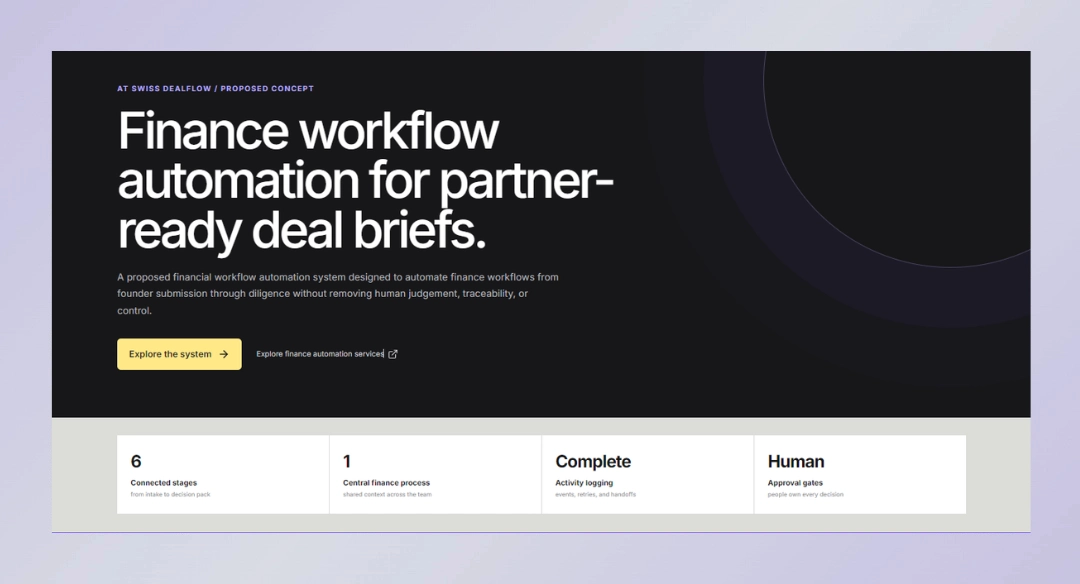
The concept demonstrates how founder intake, pitch-deck extraction, approved enrichment, transparent screening and partner review can operate as one traceable process. Automation prepares the evidence; investment professionals retain the decision.
Opportunities can arrive through forms, referrals, email, shared documents and pitch decks. Reviewers repeatedly locate company facts, identify missing files, assess thesis alignment, assign follow-up and rebuild context for partner review.
Important facts arrive in different formats, with uneven completeness and evidence quality.
Notes, documents, enrichment results and review decisions can become separated across tools.
A triage score must expose its criteria and sources—it cannot become an automated investment verdict.
The proposed pipeline creates a consistent operating record for every opportunity. Stages, owners, missing documents, review tasks and activity history stay visible as the deal moves forward.
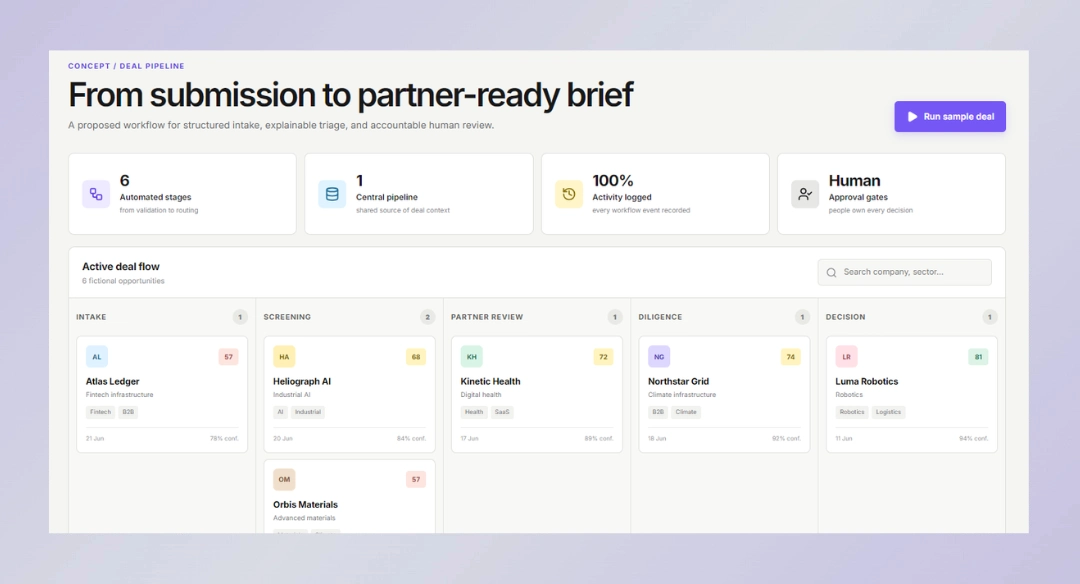
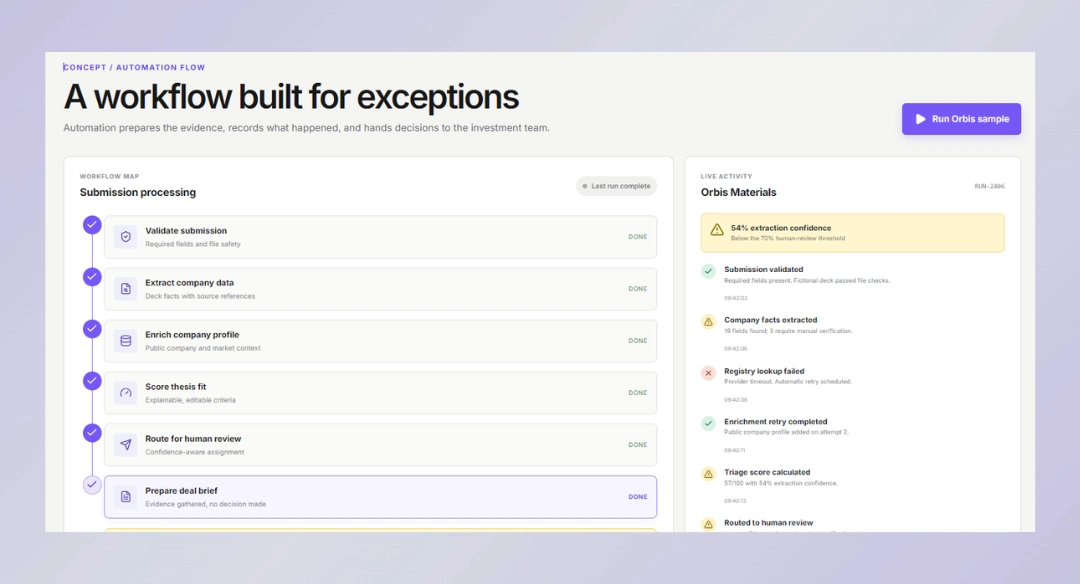
The concept deliberately includes uncertain extraction and an enrichment failure. These conditions do not disappear inside the model: they pause, retry under a defined policy or create a review task with the relevant evidence attached.
This proposed architecture demonstrates how AI workflow automation can keep extraction, scoring, routing, and exception handling inspectable while preserving human approval for every investment decision.
Check fields, expected documents, file safety and basic formatting.
Structure company, team, market, traction and funding information with evidence.
Add approved context and handle provider failures under a defined retry policy.
Apply versioned criteria and expose the component-level score breakdown.
Consider confidence, gaps and risk signals before assigning the next reviewer.
Assemble verified evidence, open questions and diligence work for partner review.
Reviewers can inspect each screening component, its source information, confidence and criteria version. The interface highlights missing documents, extraction uncertainty, risks and the recommended next verification step.
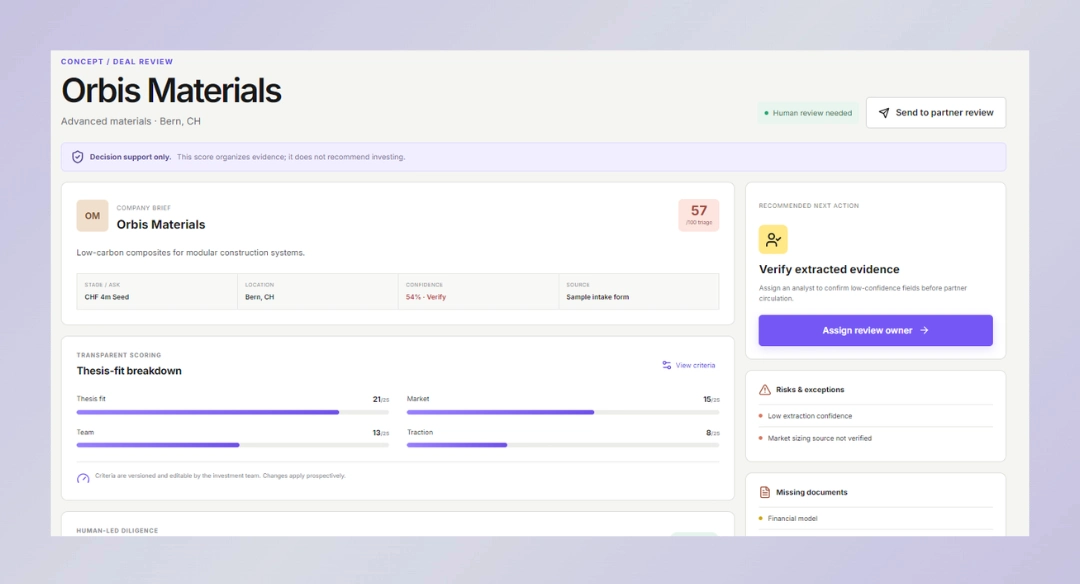
Because this is a proposed concept, the outcome is an accountable architecture rather than a claimed time or conversion result. Each stage has a purpose, evidence trail, owner and exception path.
No. It is explicitly presented as a proposed workflow concept showing how a six-stage investment-review process could be structured.
No. The score supports triage and review prioritization. Partners and committee members retain the final decision.
Each field retains source and confidence information. Low-confidence results pause for human verification.
A production implementation could update approved CRM fields and stages through scoped, permission-based integrations.
See how an n8n workflow connects email classification, live Shopify context, multilingual response preparation and human escalation.
Design the process, human controls and integration boundaries before implementation.